
Welcome to our deep dive into RF Score, a metric designed to quantify player performance at the poker table. In this post, we will explore what RF Score is, why it's important, how it's calculated, and how you can improve your score using the RF App.
What is RF Score?
RF Score is a numerical representation of a player's performance, incorporating various aspects of gameplay to provide a measure of skill and consistency. This score helps in standardizing player performance, accounts for both luck and variance, and provides insights based on live data.
Why we have an RF Score
Standardizing player performance
RF Score aims to be a universal benchmark for evaluating player actions, making it easier to compare performance across different games and sessions. Players will be able to feel their skill improving or regressing based on a single number's fluctuation.
We have the hardware to capture the necessary information
Our tables capture every action that takes place in the game, and we leverage that level of insight in order to create a singular data point that reflects all aspects of a player's performance. With our tables' capabilities, RF Score can adjust and provide feedback, making it a tool for any player looking to understand their game and pinpoint where improvement is possible.
Accounting for luck and variance
Poker is a game that incorporates both luck and skill. RF Score takes both into account, so that a player's skill level is reflected. One's RF Score is continually influenced by the occurrence of bad beats and coolers, the quality of starting hand selection, all-in EV, and more, in order to implement variance into the final number.
In poker, what is correct?
In poker, there's often no singular correct way to play. Although we generally strive to make strong decisions at every point, specific adjustments based on your exact opponents are necessary. When calculating RF Score, historical trends as well as consistency contribute to determining how consistently a player is winning and whether that is due to variance or skill.
Therefore, to calculate RF Score we utilize a number of data points from all played sessions, weighting certain aspects appropriately in order to produce a nuanced view that captures the complexity of player decisions as it relates to strong play. What we do not do is try to compare you to the most game-theory-optimal play style or check your decisions directly against a solver. We understand that every decision is unique to your situation, and your prior experience with other players on the table.
How we calculate RF Score
Hand analysis
Each hand is scored based on how well the player performed, considering factors like strong moves and missteps. Each hand gets a basic importance score which increases if the player made significant actions like raising preflop or moving all-in. Here is a list of metrics that we continually capture and update at our tables:
- VPIP (voluntarily put in pot): percent of preflop hands where the player voluntarily put money in the pot.
- PFR (preflop raise): percent of preflop hands where the player raised.
- RFI (raise first in): percent of preflop hands where the player raised when all previous players folded.
- Optimal RFI: percent of preflop hands that were correctly opened or folded from a specific position.
- Limping: percent of preflop hands where the player limped, including overlimping.
- 3-bet: percent of preflop hands where the player 3-bet when there was an open before them.
- Cold call 2-bet: percent of preflop hands where the player cold called a single raise.
- Cold call 3-bet: percent of preflop hands where the player cold called a 3-bet.
- AFQ (aggression frequency): percent of postflop actions that were bets or raises.
- WTSD (went to showdown): percent of postflop hands that went to showdown.
- C-bet (continuation bet): percent of hands where the player bet the flop after being the preflop aggressor.
- Bluffs: percent of hands with a relative strength under 40% that are bet.
- Value bets: percent of hands with a relative strength over 75% that are bet.
Each statistic has an optimal range. Points are assigned based on how close the player's stat is to that range, with a reduction as a player's actions depart from it.
Session analysis
RF Score accounts for number of players, field size, and game modes in order to get a better understanding of the context in which decisions were made. Your stats are compared to other situations in similar contexts.
We adjust the score of each hand based on its importance weight and combine them for the whole session. Although we look at each hand on its own, putting sessions of hands together helps reflect game style for that point in time.
Since players can change behavior over time, we weigh your most recent hands more than your oldest hands. This allows you to learn from mistakes, make changes, and see them reflected in your score over smaller sample sizes.
Player analysis
We mix the adjusted scores from each session with a player's prior game statistics to get a balanced view of performance, giving more weight to recent games.
Results are also a small fraction when calculating RF Score. For tournaments, finishing place is noted with considerations for field size. For cash games, resulting big blinds per 100 hands dictates the session score. In both examples, the resulting session is then weighted, with more recent sessions weighted more heavily than older sessions. Although results alone are not the most accurate reflection of skill, accounting for consistency and variance helps determine if a play style is making a winning player.
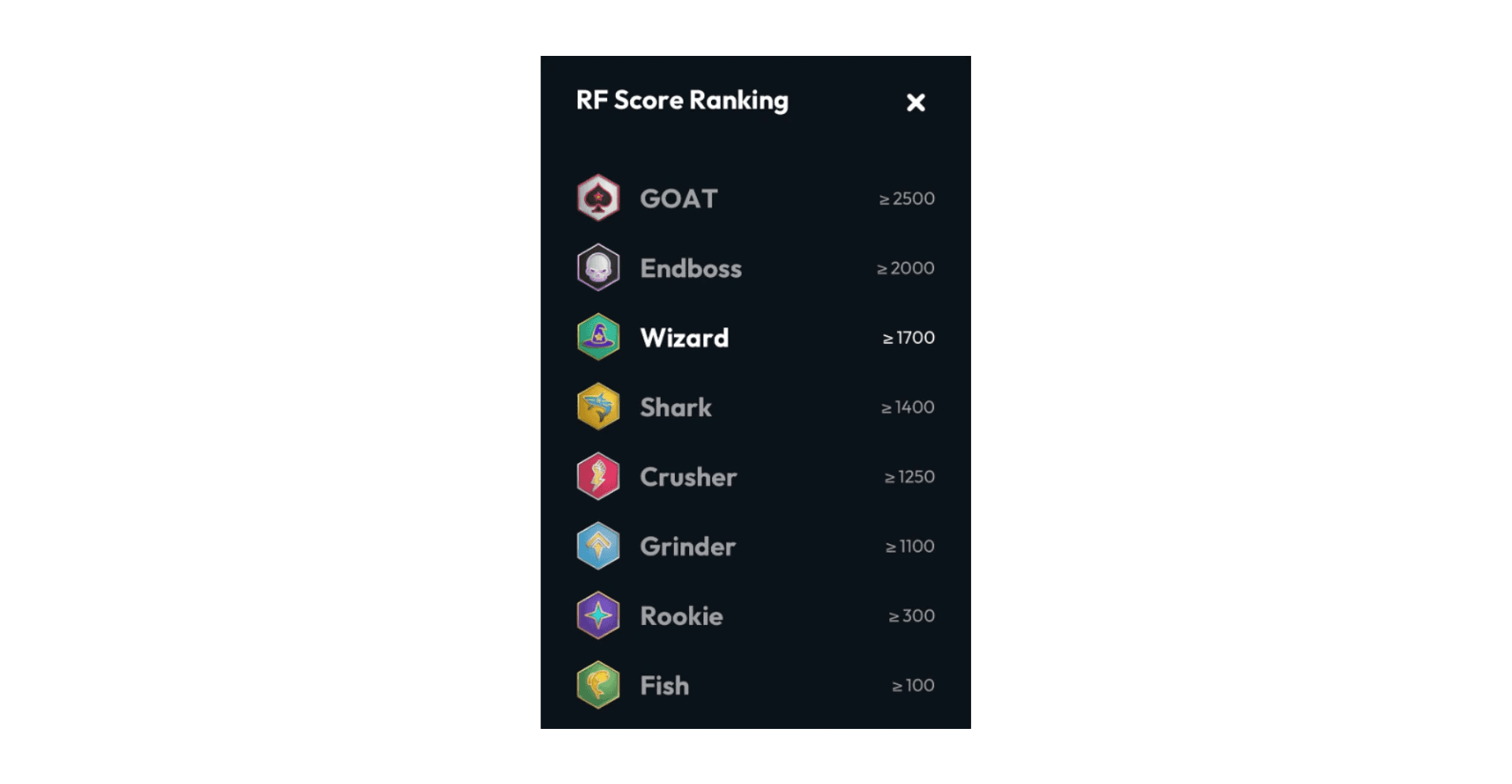
We combine these adjusted scores to get the final RF Score, which reflects overall performance and consistency. We use RF Score to determine a ranking, with Fish being the lowest and GOAT being the highest.
What you can do to improve your RF Score
Using the RF App, you can gain insights into what you're doing right and where you can improve. The app provides feedback on your gameplay, helping you make informed decisions.
For specific hand questions, players can review past actions exactly as they happened at the table, with feedback for how the hand was played. For a deeper strategic dive, players can also receive an analysis of every hand with a single tap.

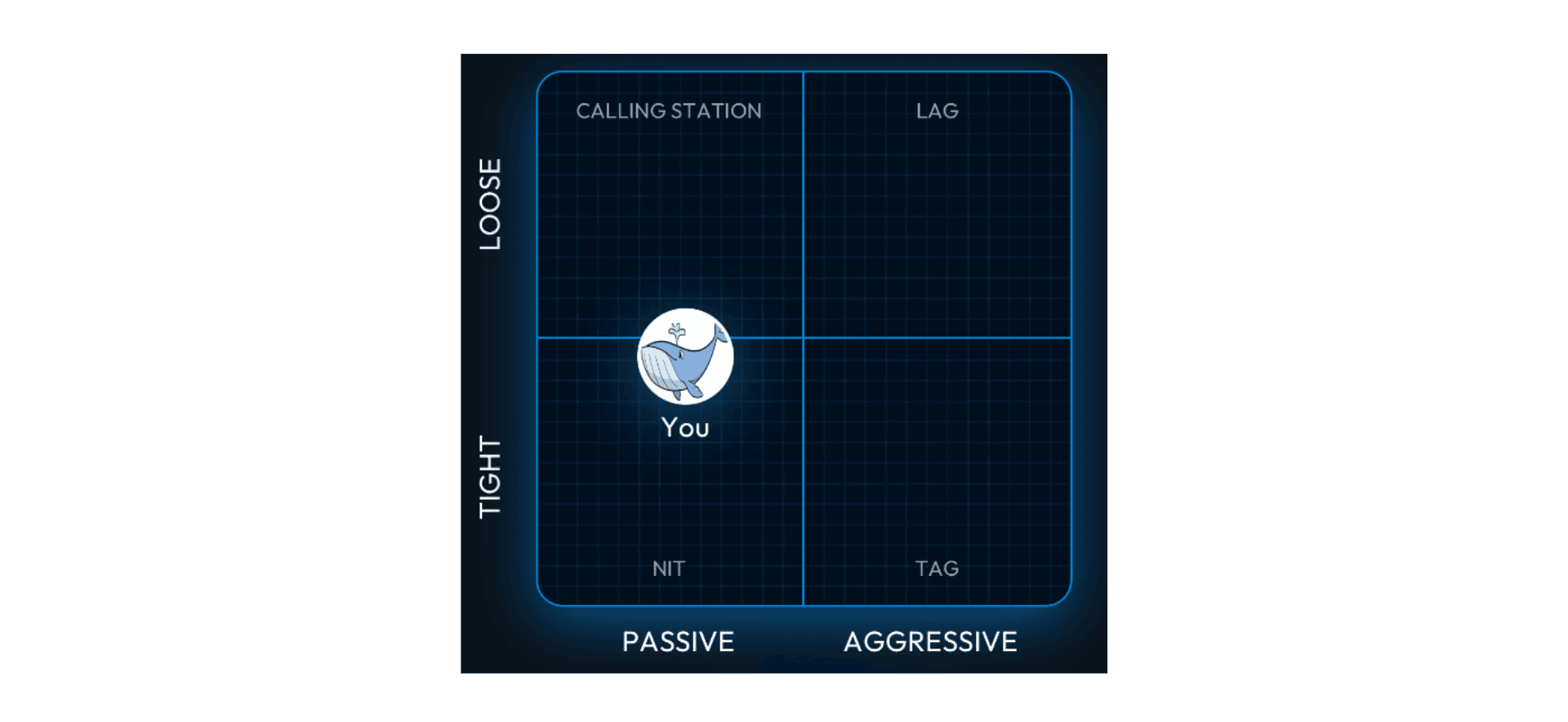
The play-style grid on the in-app profile provides a visual understanding of how an approach to poker is perceived as it relates to RF Score. Players should strive for balance between aggression and passivity, as well as balance between tight and loose decision-making. Tight players fold a lot of hands preflop and fold to aggressive bets at high frequencies. Loose players play a lot of hands and call down regularly. Aggressive players will raise and lead into pots, and passive ones feel at home when calling or folding. Tight and loose reflect hand selection and continuing frequencies, whereas aggressive and passive reflect bet sizing and frequencies.
As we collect more data and get feedback from players, we will continuously improve the accuracy of RF Score and how players can use it to improve their gameplay. Stay tuned for additional tips, strategies, and insights.
Good luck at the tables.